Van Gogh had painted flowering orchards before. Soon after arriving in Arles in 1888, he worked among rows of peach, apricot, pear, and plum trees, placing their blossoms within fields, fences, distant houses, and the open landscape of Provence.
The painting he made at Saint-Rémy in February 1890 is markedly different.
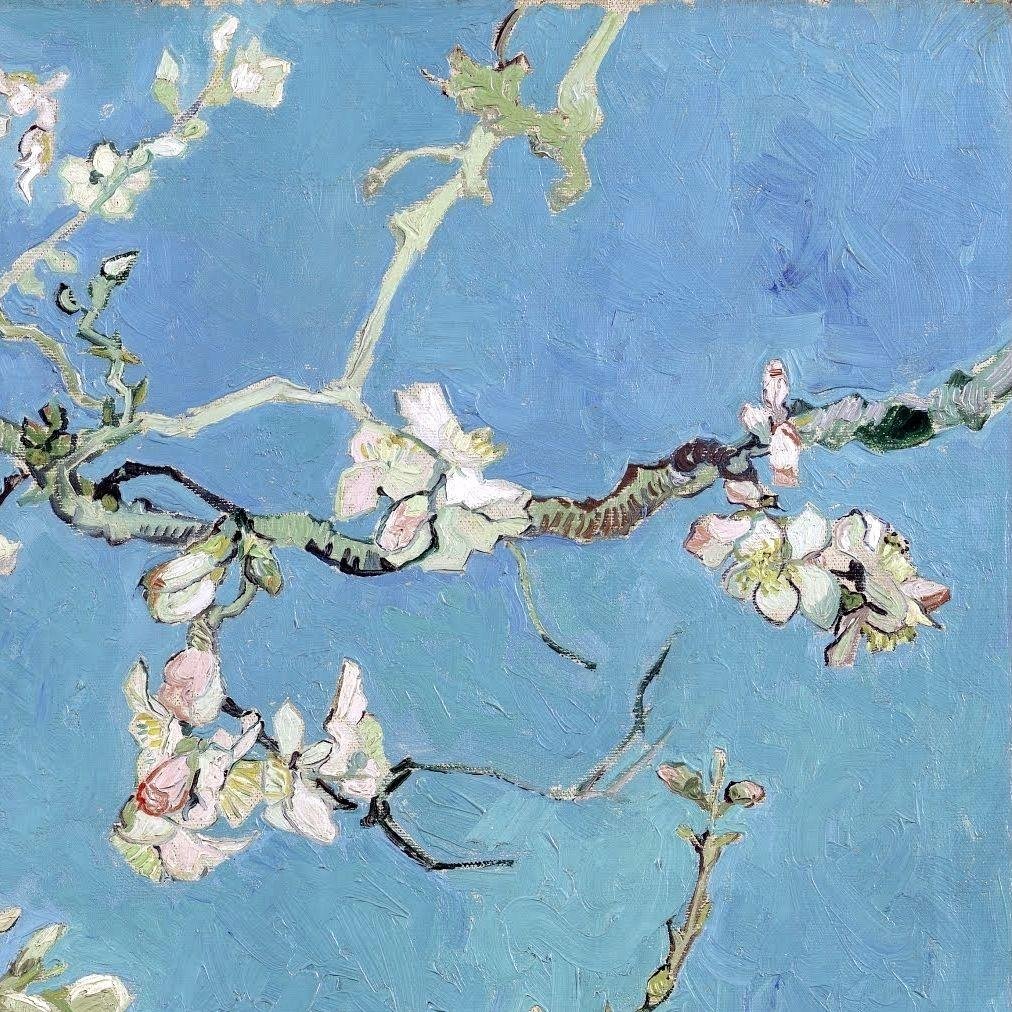
There is no orchard to enter, no visible ground, and no horizon. Thick branches extend diagonally across the canvas, some cut by its edges. Behind them is an almost uninterrupted expanse of turquoise-blue. The familiar distance between viewer and landscape has disappeared; we seem to be standing beneath the tree, looking upward.
Van Gogh gave unusual attention to the individual blossoms. Some remain tightly closed. Others have begun to open, while several are already in full bloom. Dark outlines hold the pale petals against the blue, and small touches of pink and red keep the white flowers from becoming flat or weightless.
The composition reflects years of looking at Japanese prints. Van Gogh admired their cropped forms, strong contours, broad areas of color, and viewpoints that did not depend on conventional Western perspective. In Almond Blossom, a nearby branch becomes the entire pictorial world.
Yet the painting is not a copy of a particular Japanese image. Van Gogh brought together a way of seeing learned from prints, a flowering tree observed in southern France, and the density and texture of oil paint. The result is both decorative and closely studied, spacious and physically present.
The restraint of the picture can seem surprising beside the forceful brushwork and turbulent skies most readily associated with Van Gogh. But it does not sit outside the rest of his work. Flowering trees had occupied him since Arles; what changed was the distance from which he approached them.
The broad orchard became a single branch. The landscape became an intimate field of attention.
That intimacy was not accidental. The circumstances preserved in Van Gogh’s letters tell us for whom the painting was begun—and place its serene surface within several unsettled weeks of his life.
Looking Closely at Almond Blossom