
Today, Vincent van Gogh is one of the most widely recognized artists in the world.
When he died, however, his work had not yet received anything close to the recognition it holds today. His paintings and letters survived and passed to later generations because of one person’s sustained devotion.
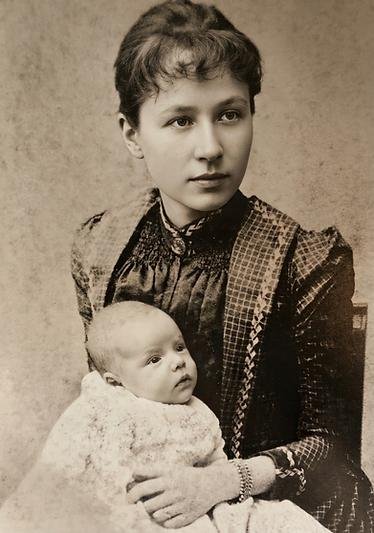
She was Theo van Gogh’s wife and the mother of the child who received Almond Blossom: Johanna van Gogh-Bonger.
Left Alone Less Than Two Years After Her Marriage
Johanna was born in Amsterdam in 1862 and worked as an English teacher. She met Theo through her brother Andries Bonger, and the couple married in April 1889.
Their son, Vincent Willem, was born the following January. On hearing of his nephew’s birth, Van Gogh painted Almond Blossom in Saint-Rémy as a gift for the child.
The family’s happiness did not last long.
Vincent died in July 1890. Theo’s health then deteriorated rapidly, and he died in January 1891. At twenty-eight, less than two years after her wedding, Johanna was left alone with her infant son.
She also inherited the many paintings and drawings Theo had kept, along with the brothers’ correspondence: the vast legacy of an artist whose importance was still largely unrecognized.
Inheriting Theo’s Faith in Vincent
Theo had believed deeply in his brother’s talent. He supported Vincent’s living and working expenses and, as an art dealer, searched for ways to introduce the work to others. He did not live long enough to complete that task.
As Johanna read the letters and studied the paintings her husband had left behind, she began to understand both the bond between the brothers and the depth of Vincent’s art.
The letters described his ideas for paintings, his thoughts about color, the books he was reading, the people he met, and his struggles with money and health.
Johanna did not see the paintings and letters as separate relics. If the pictures revealed the world Vincent saw, the letters revealed the mind and heart with which he saw it. She believed the two had to be shared together if people were to understand his art fully.
Sending the Work Out into the World
Johanna moved with her son to Bussum in the Netherlands, where she ran a boarding house. While earning their living, she also began the work of building Vincent’s reputation.
She introduced his art to painters, critics, and dealers, organized exhibitions, and lent works to shows. Although she sold paintings, she did not release the entire collection onto the market at once.
She kept important works within the family collection while carefully choosing when others should be exhibited, loaned, or sold. Through this process, Van Gogh’s paintings entered galleries, private collections, and museums, gradually reaching a wider public.
Johanna was more than the heir who physically safeguarded the work. She became an early collection manager and an active advocate for Van Gogh’s art, deciding what to show, where to lend it, and when to sell.
Bringing Van Gogh’s Work Together in 1905
A turning point came in 1905.
At the Stedelijk Museum in Amsterdam, Johanna organized the largest Van Gogh retrospective held up to that time. Rather than presenting one or two paintings among works by other artists, the exhibition allowed visitors to encounter the range and development of Van Gogh’s art in one place.
An artist’s reputation is rarely established by a single masterpiece.
People must be able to see the work; critics must write about it; museums and collectors must preserve it. When paintings previously scattered apart are brought together, viewers can begin to understand the full arc of an artist’s practice.
Johanna patiently created those conditions.
Read Johanna’s story at the Van Gogh Museum
Publishing the Letters and Preserving the Voice Behind the Paintings
Alongside her work on the paintings, Johanna organized the letters Vincent had written to Theo.
They showed that Van Gogh was not an artist driven by impulse alone. He read widely in literature and art, studied color and composition without pause, and thought deeply about the purpose of his work.
After the long process of selecting, dating, and ordering the correspondence, Johanna published a Dutch edition of Vincent’s letters to Theo in 1914.
Readers could now encounter Van Gogh’s voice alongside his paintings. The letters began to be read both as records illuminating the work and as writing that carried the thoughts and life of a human being.
Learn how the paintings and letters were preserved after Vincent’s death
The Two Generations Connected by Almond Blossom
Johanna’s son, Vincent Willem, grew up to become an engineer.
After his mother’s death, he inherited the family collection. In 1962, he established the Vincent van Gogh Foundation. The works preserved by the foundation became the core collection of the Van Gogh Museum, which opened in 1973.
Almond Blossom, painted by Van Gogh to celebrate his nephew’s birth, traveled through that long history as well.
An artist made a painting for a newborn child. The child’s mother brought the artist’s work and letters to the wider world. When the child grew up, he created the foundation that would carry that legacy into the future.
We can look at Almond Blossom in a museum today not simply because the canvas happened to survive.
Someone believed in its value, cared for it, and made the choices necessary to bring it into public view.
The artist’s name remains beside the work. Yet behind the painting’s journey through time lies another person’s patient, often unseen labor of care and judgment.