We remember Vincent van Gogh first through his paintings.
Yellow sunflowers, a deep blue night sky, swaying cypresses, and an almond tree in bloom. Yet the paintings alone cannot tell us everything about what he saw or why he chose those colors.
His letters offer a way into those questions.
They preserve the uncertainty and failure behind finished works, the books he was reading, the difficulties of daily life, and his hopes for the future. Today, they are read as more than an artist’s record. They feel like another body of work—one in which Van Gogh shaped his life and art through language.
Theo, His Longest-Standing Correspondent
More than 900 letters from Van Gogh’s correspondence are known today. Of these, over 800 were written by Vincent, most of them to Theo, his younger brother by four years. Their correspondence extended from around 1872 until Vincent’s death in 1890. Explore Van Gogh’s letters at the Van Gogh Museum
Theo supported Vincent’s living and working expenses, but money alone cannot explain their relationship.
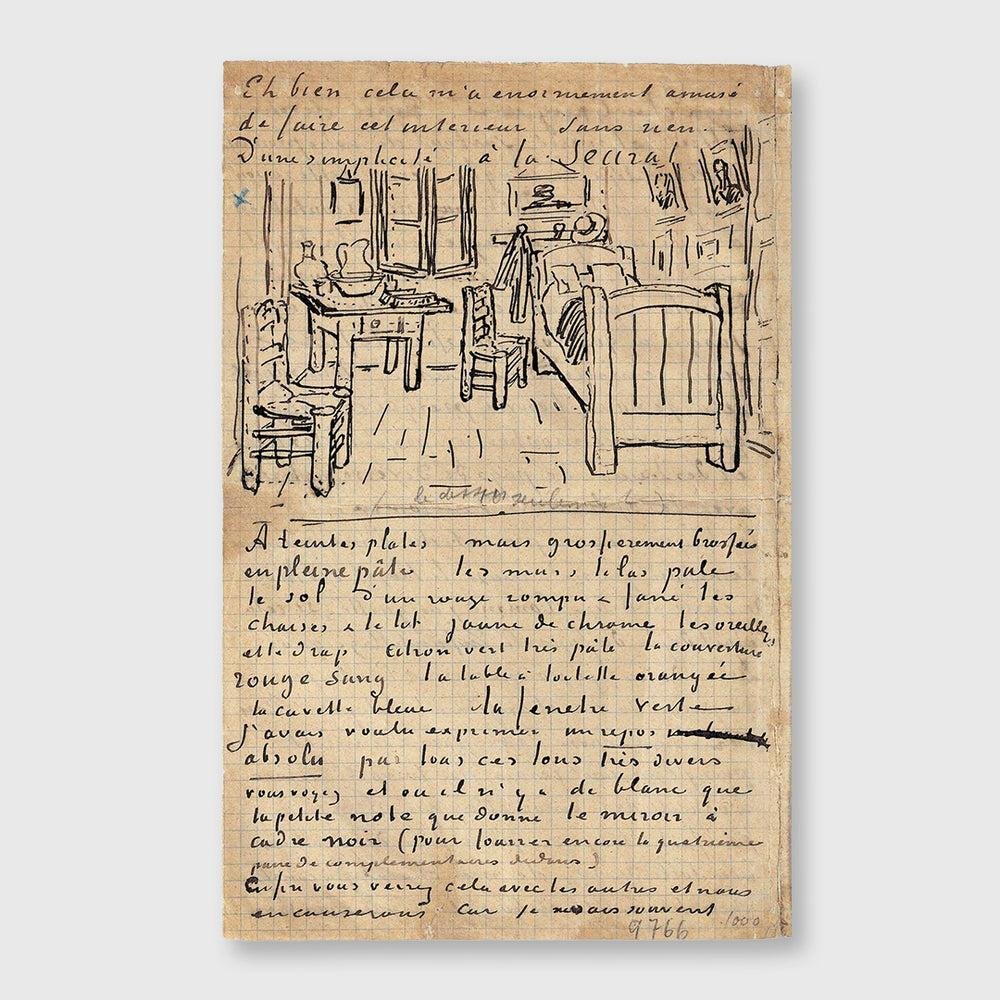
Vincent described the landscapes he saw, the paintings he had begun, and his thoughts on exhibitions and the art world. Sometimes he included a small sketch of a composition. He explained the colors he intended to use and the atmosphere he hoped the finished canvas would hold.
Because Theo worked as an art dealer and encountered new currents in art, he was also an important adviser and source of information for Vincent. He shared news of other artists and reactions from the art world, while helping to preserve and promote his brother’s work.
For Vincent, writing a letter was both a way to speak to a distant brother and a process for organizing his practice and testing his ideas.
Paintings First Drawn in Words
Van Gogh’s letters are remarkable because they bring us close to the making of his paintings.
He did not describe nature simply as beautiful scenery. He repeatedly considered how the colors he saw related to one another and what feeling his brushwork might convey.
In Arles, he wrote about the intense southern light, the Yellow House, sunflowers, and the night café. In Saint-Rémy, he recorded cypresses, olive trees, the hospital garden, and the surrounding landscape. He was equally candid when he felt a painting had failed.
Read beside the paintings, these letters make the finished canvases appear in a different light.
We see not only the result, but also what the artist chose and what he abandoned. The letters are commentaries on Van Gogh’s art, but they are also the first drafts of paintings not yet complete.
A Record of Van Gogh Beyond the Canvas
The letters contain far more than discussions of art.
Van Gogh read the Bible and literature, and wrote about authors including Charles Dickens and Émile Zola. He thought deeply about the lives of working people, poverty, religion, and the human need for consolation.
He did not hide the days when money ran short or the periods when his health failed. He confessed loneliness, anxiety, and difficulty connecting with others. Alongside these admissions, he wrote of the resolve to begin working again and the hope of making better paintings.
This is not the simplified Van Gogh of the familiar “mad genius” myth.
The man in the letters constantly connected what he read with what he saw and considered, over many years, what kind of artist he wished to become. Even when his emotions overwhelmed him, he tried to hold his thoughts steady in sentences.
That candor and precision of observation allow the letters to reach readers today as more than documents from another century.
How Private Letters Entered the Public World
After Vincent and Theo died, the correspondence passed to Theo’s wife, Johanna van Gogh-Bonger.
Reading the letters helped Johanna understand both the relationship between the brothers and the world of Vincent’s art. She came to believe that the paintings and correspondence had to become known together if people were to understand Van Gogh fully.
After years of selecting and organizing the material, Johanna published a Dutch edition of Vincent’s letters to Theo, Brieven aan zijn broeder, in 1914. Read about the Van Gogh Museum’s research on Johanna
For the first time, readers could encounter the voice behind the paintings as a sustained narrative.
The letters were later translated and studied in many languages, becoming essential sources for the dates and circumstances of Van Gogh’s work. Today, the Van Gogh Letters online edition, created by the Van Gogh Museum and the Huygens Institute, allows readers to explore the original texts, translations, annotations, and the sketches included in the letters.
How Did the Letters Become Literature?
Van Gogh did not write these letters with the expectation that they would one day be read as literature.
Most were private messages to his brother, family members, or fellow artists. Yet we read them as literature because they record a life in a distinctive voice.
In his descriptions of landscape and color, we feel the painter’s eye. When he confides his fears to Theo, we encounter the vulnerability of a human being. In his repeated return to painting after disappointment, we recognize a determination not to give up on life.
Literature does not exist only as fiction or poetry.
A truthful record of how one person saw the world—what he loved, and what made him falter—can cross time and reach another person’s heart.
Van Gogh’s letters do not offer the polished story of a successful artist. They preserve the voice of someone who did not yet know his future, sharing the anxieties and hopes of the present with his brother.
If the paintings are the world Van Gogh saw, the letters are the mind and heart of the person who saw it.
When we encounter both, we move beyond Vincent van Gogh the famous artist and come closer to a man who read, reflected, and tried to transform his life into art.