
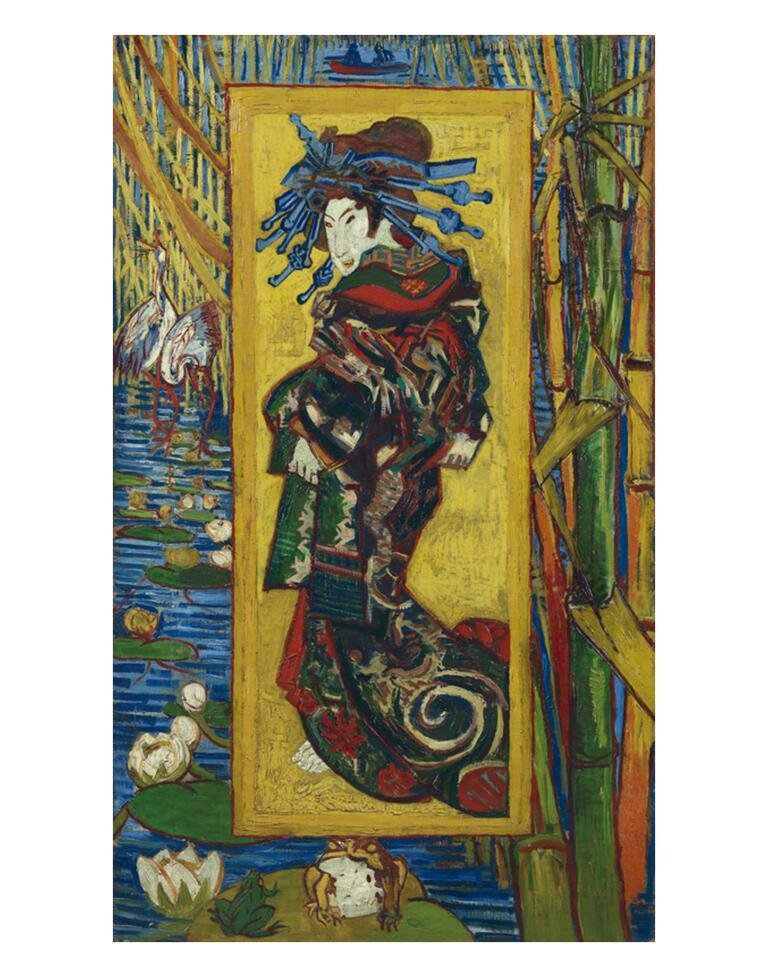
From ukiyo-e to Almond Blossom: how Japanese prints transformed Van Gogh’s way of seeing
Vincent van Gogh never visited Japan.
And yet Japan is essential to understanding his art. Van Gogh did more than collect nineteenth-century Japanese woodblock prints, known as ukiyo-e. In them, he discovered a way of looking at nature and the world that differed radically from the conventions of Western painting.
Japanese prints were not simply a fashionable source of decorative details. They changed the way Van Gogh composed an image, used color, and selected a fragment of nature to fill the picture plane.
Discovering Japanese Prints in Paris
In late nineteenth-century Europe, interest in Japanese art and decorative objects grew rapidly. This cultural phenomenon became known as Japonisme.
As trade between Japan and the West expanded, woodblock prints, ceramics, textiles, fans, and other objects entered European markets. Their daring compositions and flat areas of color revealed new visual possibilities to artists accustomed to traditional perspective and modeled light and shadow.
Van Gogh began buying Japanese prints while living in Antwerp and became a serious collector in Paris. Together, he and his brother Theo assembled several hundred prints.
At first, Van Gogh bought them to decorate his rooms or to resell. Over time, however, he began to study their artistic language closely.
Reimagining Hiroshige in Paint
Van Gogh did not stop at looking. He translated Japanese prints into oil paintings of his own.
Among the best-known examples are Flowering Plum Orchard and Bridge in the Rain, both based on prints by Utagawa Hiroshige. Van Gogh retained the basic compositions but intensified the colors and added decorative Japanese characters around the edges—characters he could not read.
In Courtesan (after Eisen), based on a figure by Keisai Eisen, he enlarged the woman from the original print and surrounded her with bamboo, water lilies, cranes, and frogs.
These paintings were not attempts at exact reproduction. By reinterpreting another artist’s image through his own colors and materials, Van Gogh learned how its composition worked.
What Japanese Prints Taught Him About Composition
Van Gogh was interested in far more than unfamiliar clothing or calligraphy.
In Japanese prints, a nearby branch or object might cut boldly across the image, while parts of a subject could disappear beyond its edges. Rather than creating depth through a horizon and vanishing point, as in traditional Western landscape painting, these prints often relied on broad planes of color and strong contours.
Weather and the seasons also became central subjects. Rain, snow, and the brief flowering of trees could transform an ordinary view into a singular moment.
Van Gogh absorbed qualities such as:
– bold cropping that lets forms continue beyond the frame
– spaces without a visible horizon
– close-up views that enlarge a fragment of nature
– broad, flat areas of color
– strong outlines that clarify form
– an attention to weather and seasonal change
These ideas did not remain confined to his adaptations of individual prints. They continued to shape the way he looked at nature.
Seeing Southern France as His Own Japan
In 1888, Van Gogh left Paris for Arles in southern France.
He was not traveling to Japan, but he hoped to find in the clear light and vivid colors of Provence something of the world he had seen in Japanese prints.
For Van Gogh, Japan was less a real country grounded in precise geography and culture than an imagined ideal—a place where artists lived together in harmony with nature. From today’s perspective, it is important to recognize that this vision reflected a romantic nineteenth-century European fantasy more than the reality of Japan.
Even so, that imagined world brought genuine change to his painting.
In Arles, Van Gogh painted flowering orchards, bridges, and fields in bright, lucid colors. He no longer needed a Japanese print beside him to imitate. He had already learned to isolate a fragment of nature and build an image with unexpected boldness.
Traces of Japan in Almond Blossom
Almond Blossom is not a direct copy of any single Japanese print.
Yet the transformation of Van Gogh’s vision through Japanese art is unmistakable.
There is no ground and no horizon. Thick branches enter and leave the canvas at its edges, while blossoms and blue sky form expansive areas of color. The dark outlines of the branches stand out sharply against the flat background.
The decision to bring one fragment of nature close and make it the subject of the entire canvas also recalls Japanese prints.
But Van Gogh did not simply borrow a Japanese style. He combined what he had learned with the texture of oil paint, his own brushwork, and an almond tree he had observed in southern France.
It is therefore more accurate to see Almond Blossom not as a “Japanese-style painting,” but as a work in which Van Gogh transformed principles learned from Japanese prints into a language entirely his own.
When Looking at Another Culture Changes an Artist’s Work
What Van Gogh found in Japanese prints was more than a new set of subjects.
Through the art of another culture, he was able to step outside the familiar rules of Western painting. He could reconsider whether every landscape needed a horizon, whether the principal subject belonged at the center, and whether realistic modeling was necessary to suggest depth.
The result was a new sense of open space, cropping, color, and rhythm in his work.
Beneath the blue sky of Almond Blossom are not only a tree observed in southern France and the wish to celebrate his nephew’s birth. There is also the influence of Japanese prints—images Van Gogh had collected and studied closely for years.
A work of art is not always born from one person or one place. Images and cultures separated by great distances can meet within an artist’s eye and blossom again as something entirely new.